IWC Watches
IWC Schaffhausen is a Swiss watch manufacture founded in Schaffhausen in 1868 by the American watchmaker and engineer Florentine Ariosto Jones. His idea was unusual for the period: combine modern American production methods with the skills of Swiss watchmakers. More than 150 years later, IWC remains based in Schaffhausen and is known for Pilot's Watches, the Portugieser, Ingenieur, Portofino and Aquatimer, as well as chronographs, perpetual calendars and advanced case materials.
IWC has belonged to the Swiss luxury group Richemont since 2000. Christoph Grainger-Herr is the company's CEO. Although its founder was American, IWC was established in Switzerland and has remained a Swiss watch manufacturer throughout its history.
An American idea in Schaffhausen
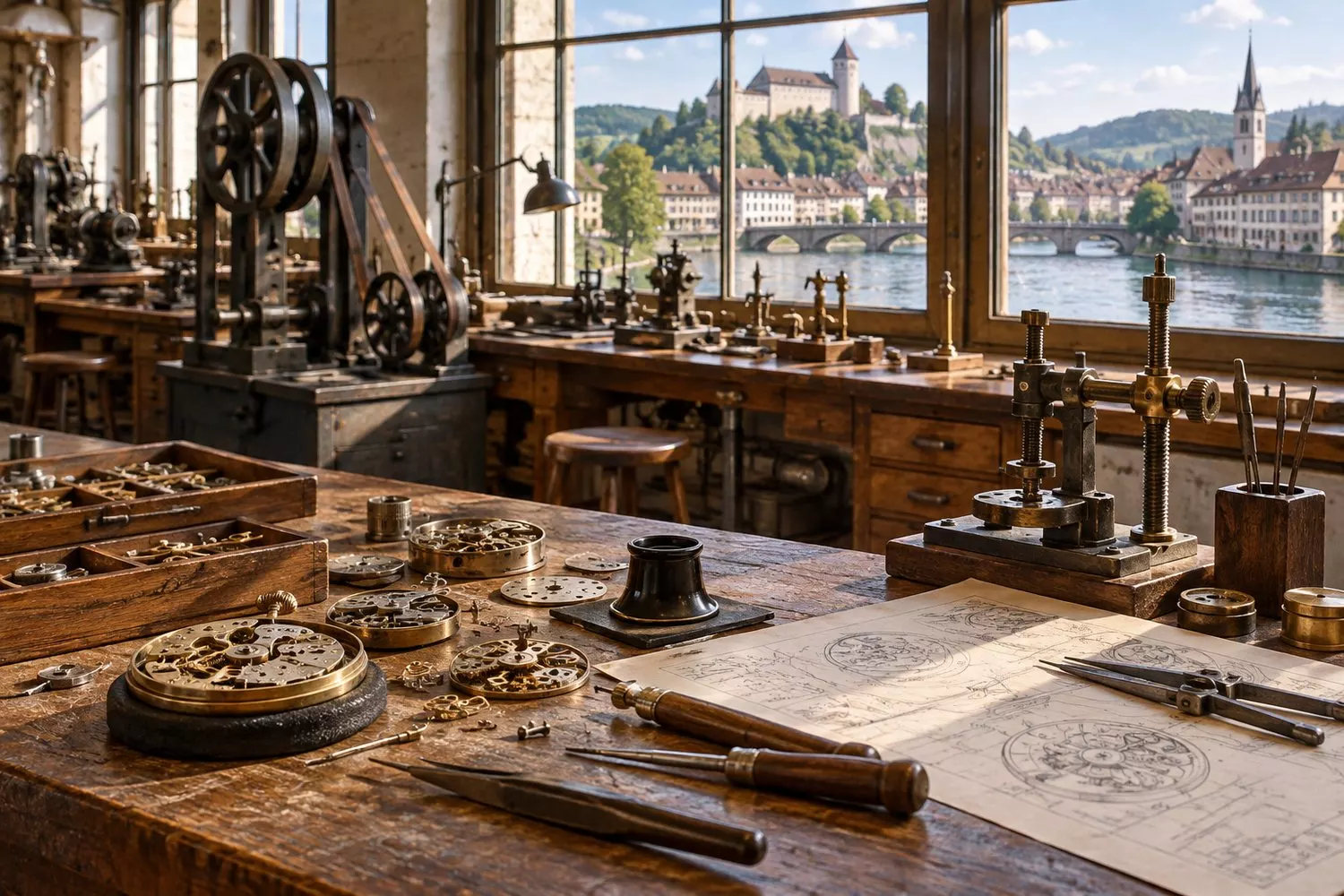
Florentine Ariosto Jones had worked for E. Howard Watch & Clock Co. in Boston before travelling to Switzerland in search of a place to establish his own watchmaking business. He wanted to apply the mechanised production methods developing in the United States to Swiss watchmaking, while retaining skilled hand-finishing, assembly and regulation.
Jones found the conditions he needed in Schaffhausen, away from the traditional watchmaking centres of western Switzerland. The city offered modern industrial infrastructure and, importantly, water power from the Rhine for machinery. In 1868 Jones and fellow American watchmaker Charles Kidder established the business from which the International Watch Company developed. Early movements from this period are now commonly known as Jones calibres.
Jones did not remain in control permanently. The company passed into local ownership and, from 1880, was associated with the Rauschenbach family of Schaffhausen. This helped anchor what had begun as an American industrial idea firmly in the Swiss city where IWC remains based today.
From pocket watches to wristwatches
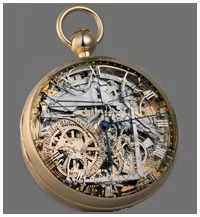
IWC initially built its reputation with pocket-watch movements. In 1885 it began producing watches using the Pallweber system, which displayed the hours and minutes with numerals rather than conventional hands. By the end of the 19th century, IWC was also producing early wristwatches using compact pocket-watch movements.
In 1915 the company introduced calibres 75 and 76, its first movements designed specifically for wristwatches. During the following decades IWC increasingly developed watches around particular practical requirements rather than treating the wristwatch simply as a smaller pocket watch.
Pilot's Watches and the Portugieser
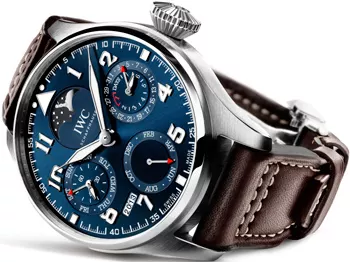
IWC's aviation-watch history began in 1936 with the Special Pilot's Watch. It had a rotating bezel with an arrowhead index for recording short periods of time and an antimagnetic escapement. In 1940 IWC developed the large Pilot's Watch Calibre 52 T.S.C., an observation-style watch with central seconds.
Another important IWC family began in 1939 after two Portuguese importers requested large wristwatches with the precision of marine chronometers. IWC answered by placing high-precision pocket-watch movements in large wristwatch cases. These watches became the origin of the collection now known as the Portugieser.
Albert Pellaton and the Ingenieur
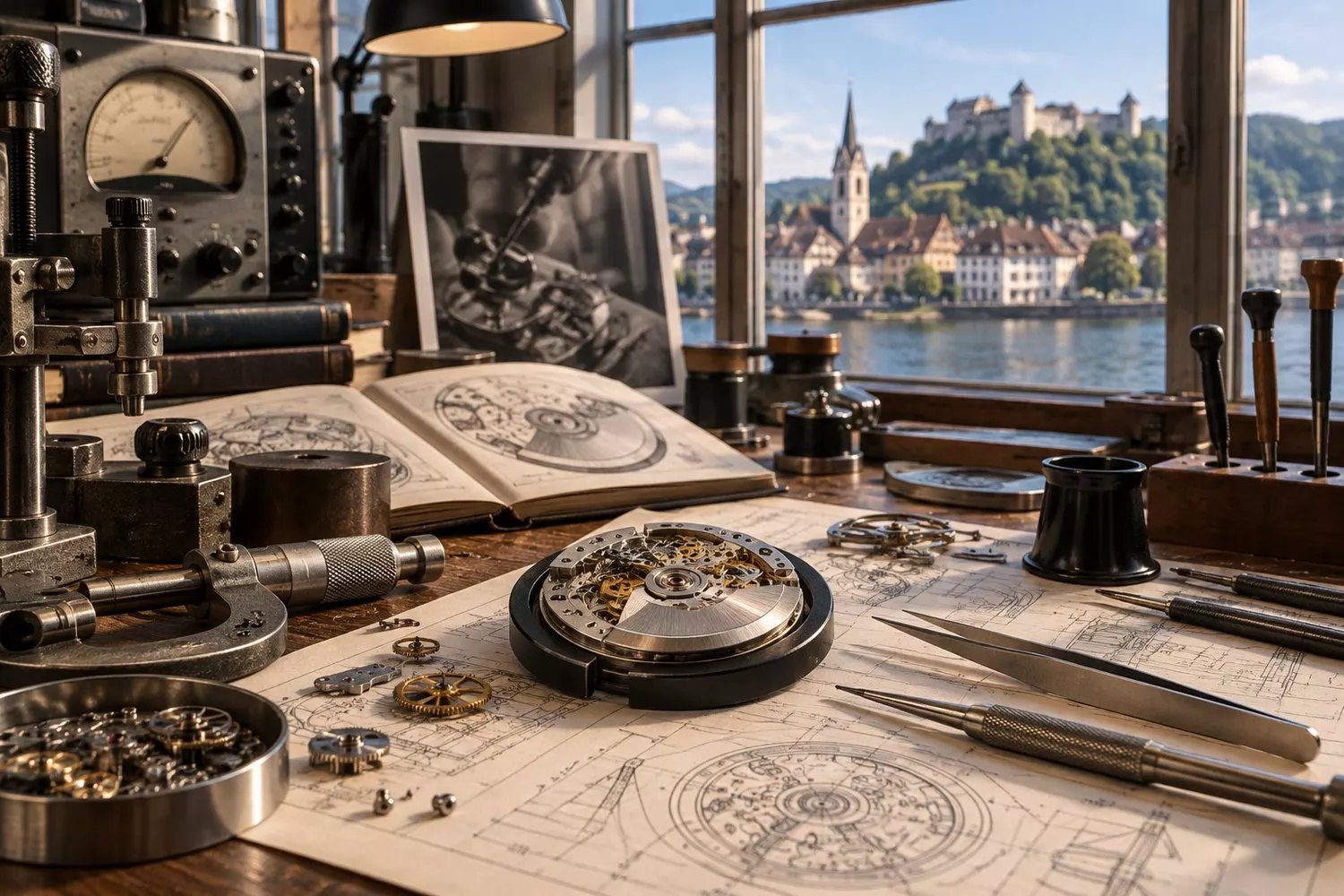
Albert Pellaton became IWC's technical director in the 1940s and shaped the company's post-war engineering. His work included the calibre 89 and a highly efficient bidirectional automatic winding mechanism that became known as the Pellaton winding system. Modern versions of the principle continue to be used in IWC manufacture movements.
The Ingenieur appeared in 1955 with the automatic calibre 85 and a soft-iron inner case designed to protect the movement from magnetic fields. The collection was conceived for engineers, scientists and other professionals working around increasingly common electrical equipment. In 1976, Gérald Genta redesigned the Ingenieur as the Ingenieur SL, giving the technical watch a bold integrated-bracelet form that continues to influence the modern collection.
Diving watches, Porsche Design and new materials
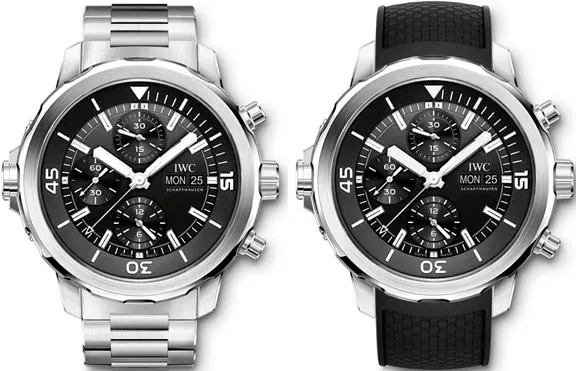
IWC introduced its first Aquatimer diver's watch in 1967. Instead of a conventional external timing bezel, it used an internal rotating bezel beneath the crystal, controlled by a second crown, and was water-resistant to 200 metres.
After VDO Adolf Schindling AG acquired IWC in 1978, Günter Blümlein became one of the central figures in the company's revival during the difficult years of the quartz crisis. IWC also began working with Porsche Design. In 1980 the collaboration produced the Porsche Design Titanium Chronograph, which IWC describes as the first wristwatch with a titanium case. The Ocean 2000 diving watch followed in 1982 and was pressure-resistant to 200 bar.
Da Vinci and the return of mechanical complications
At the height of the quartz era, IWC watchmaker Kurt Klaus developed a mechanical perpetual calendar designed to be unusually simple for its user. Presented in the Da Vinci Perpetual Calendar in 1985, its calendar displays could be advanced together through the crown. The mechanism automatically accounts for different month lengths and leap years, while its four-digit year display became one of the watch's distinctive features.
IWC continued exploring both complications and materials. In 1986 it introduced a Da Vinci Perpetual Calendar with a case made from black zirconium-oxide ceramic. The Grande Complication followed in 1990, combining several demanding mechanical functions in a single wristwatch.
Richemont and the modern manufacture
Richemont acquired IWC in 2000 together with Jaeger-LeCoultre and A. Lange & Söhne. IWC subsequently expanded its production capabilities in Schaffhausen while continuing to develop its own movement families, chronographs, calendars and specialised materials.
In August 2018 IWC opened a new 13,500-square-metre Manufakturzentrum on the outskirts of Schaffhausen. The facility brings production of movement components, manufacture-movement assembly and case production together under one roof. Automated machining is used where precision and repeatability are essential, while manufacture movements are assembled by watchmakers by hand.
Main IWC collections
- Pilot's Watches – the family that traces its history to IWC's Special Pilot's Watch of 1936 and includes modern chronographs, Mark models and Big Pilot's Watches.
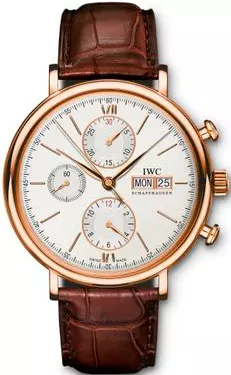
- Portugieser – large, classically styled watches descended from the wristwatches created for Portuguese importers in 1939, today ranging from simple automatics to chronographs and complicated calendars.
- Ingenieur – introduced in 1955 as an antimagnetic watch for technical professionals and later transformed by Gérald Genta's 1976 Ingenieur SL design.
- Portofino – understated round watches with a more traditional dress-watch character.
- Aquatimer – IWC's dive-watch family, whose history begins with the 1967 Aquatimer.
IWC Schaffhausen FAQ
What does IWC stand for?
IWC stands for International Watch Company, the name chosen for the watchmaking business established by Florentine Ariosto Jones in Schaffhausen.
Is IWC Swiss or American?
IWC is a Swiss watch manufacturer. It was founded in Schaffhausen, Switzerland, in 1868 by an American watchmaker and engineer, Florentine Ariosto Jones. Its unusual origin is why both American industrial thinking and Swiss watchmaking feature prominently in the company's history.
Why is IWC based in Schaffhausen?
Jones wanted to combine mechanised American production methods with Swiss watchmaking skills. Schaffhausen offered industrial infrastructure and power from the Rhine for his machinery, while being outside the established watchmaking centres of western Switzerland.
Who owns IWC?
IWC Schaffhausen belongs to Compagnie Financière Richemont, the Swiss luxury group that acquired the company in 2000.
Who is the CEO of IWC?
Christoph Grainger-Herr is the Chief Executive Officer of IWC Schaffhausen.