Ulysse Nardin Watches
Founded in Le Locle in 1846, Ulysse Nardin built its reputation on precision chronometers, above all the marine chronometers that helped navigators measure time accurately at sea. The Swiss manufacture later became known for astronomical wristwatches, unconventional complications and the Freak, a mechanical watch whose movement itself indicates the time. Today the independent company continues to develop movements and watches in Switzerland.
Origins in Le Locle and marine chronometry
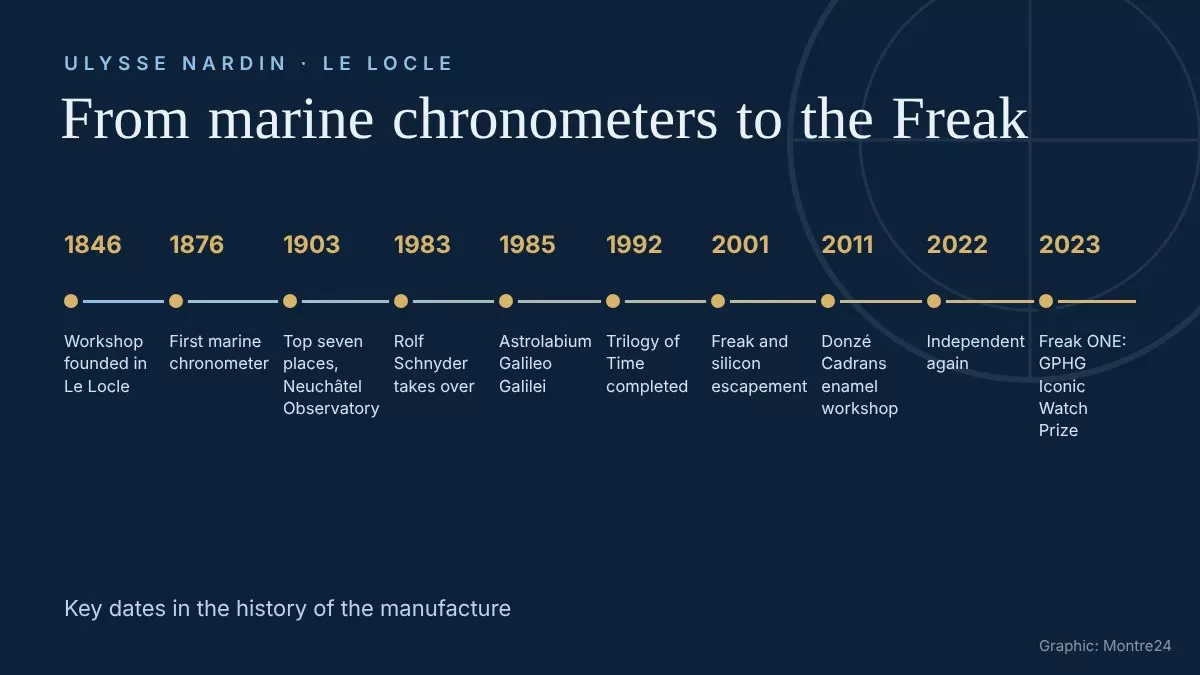
Ulysse Nardin, born in 1823 into a watchmaking family, established his workshop in Le Locle in 1846. His early work centred on precision timekeeping: pocket chronometers and complicated watches, tested against an astronomical regulator he acquired in 1860.
The workshop earned a prize medal at the London International Exhibition of 1862 for its complicated watches and pocket chronometers. In 1865, after a fire destroyed the original workshop, the company moved to Rue du Jardin 5 in Le Locle, a building that is still its headquarters today. After his death in 1876, his son Paul-David took over and introduced the company's first marine chronometer the same year. At sea, a reliable chronometer was essential for calculating longitude: even a small error in time could translate into a significant navigational error. In 1903 Ulysse Nardin chronometers took the top seven places in the trials of the Neuchâtel Observatory, and over the following decades the manufacture supplied marine chronometers to more than 50 navies.
Rolf Schnyder and the astronomical watches
In 1983, during the upheaval caused by quartz technology, entrepreneur Rolf W. Schnyder acquired Ulysse Nardin. Working with watchmaker and scholar Ludwig Oechslin, he pursued mechanical complications that went beyond conventional calendar displays. The Astrolabium Galileo Galilei, introduced in 1985, brought astronomical indications to the wrist. It was followed by the Planetarium Copernicus in 1988 and the Tellurium Johannes Kepler in 1992, completing the Trilogy of Time.
The partnership also produced technically distinctive practical complications. A quick-setting GMT mechanism appeared in 1994, followed in 1996 by the Perpetual Ludwig, a perpetual calendar whose indications can be adjusted forwards or backwards through the crown. These developments helped establish a new identity for the company, combining traditional mechanical watchmaking with experimental engineering.
The Freak and the arrival of silicon
Introduced in 2001, the original Freak departed radically from familiar wristwatch construction. It had no conventional hands, dial or crown. Instead, its rotating movement assembly served as the minute indicator, while a separate rotating element indicated the hours. The original Freak became the first wristwatch to incorporate silicon components into its escapement, marking an important step in the use of this lightweight material in mechanical watchmaking.
Subsequent developments extended this research. In 2006 Ulysse Nardin co-founded Sigatec in Sion, together with Mimotec, to manufacture silicon micromechanical components. The Freak DIAMonSIL of 2007 explored diamond-coated silicon in the escapement. Later generations, including Freak X, Freak S and Freak ONE, revisited the original concept with different movements and approaches to winding, case construction and time display.
Marine instruments, astronomical complications and specialist crafts
The company's maritime background remains visible in the Marine family, whose designs refer to historical deck chronometers. Meanwhile, its complicated watches have continued to explore celestial and tidal indications. The Moonstruck, launched in 2009, displayed lunar phases and tidal information, reflecting a tradition that began with Oechslin's astronomical creations.
Ulysse Nardin also invested in specialised production. In 2011 it acquired Donzé Cadrans, a Le Locle workshop known for enamel dials. Its work illustrates a different side of the manufacture: alongside new materials and experimental movements, traditional decorative techniques remain part of the brand's watchmaking repertoire.
Independence and contemporary Ulysse Nardin
Rolf Schnyder died in 2011, and in 2014 the luxury group Kering acquired Ulysse Nardin. The company regained its independence through a management buyout in 2022. The buyout was led by Patrick Pruniaux, chief executive since 2017. The new ownership structure allowed the manufacture to continue developing its own technical and creative direction.
In 2023 the Freak ONE received the Iconic Watch prize at the Grand Prix d'Horlogerie de Genève. The distinction reflected the lasting significance of the Freak concept more than two decades after its debut.
Main Ulysse Nardin collections
- Freak – unconventional mechanical watches in which the movement plays a central role in displaying the time; the family includes Freak X, Freak ONE and Freak S.
- Blast – contemporary high-watchmaking designs featuring skeletonised movements and complications such as tourbillons, dual-time displays and chiming mechanisms.
- Diver – sports and diving watches that connect the brand's maritime identity with modern materials and case construction.
- Marine – watches inspired by historical marine chronometers, with an emphasis on legible displays and precision timekeeping.
Ulysse Nardin also presents selected Classico and limited-edition models. Historical collections and discontinued references should be distinguished from the principal families in the current catalogue.
Ulysse Nardin FAQ
When was Ulysse Nardin founded?
Ulysse Nardin founded his watchmaking workshop in Le Locle, Switzerland, in 1846.
Where are Ulysse Nardin watches made?
Ulysse Nardin is a Swiss manufacture based in Le Locle, with watchmaking and specialist production activities in Switzerland.
Who owns Ulysse Nardin?
Ulysse Nardin became independent in 2022 following a management buyout led by Patrick Pruniaux and his team.
Why is the Freak important?
The Freak, introduced in 2001, used its rotating movement to display the time and was the first watch to use silicon components in its escapement.
What are the main Ulysse Nardin collections?
The brand currently highlights Freak, Blast, Diver and Marine as its four principal collections.