Cartier Watches
Cartier is a French jeweller and watchmaker founded in Paris in 1847. It is best known in watchmaking for a series of shaped designs created in the early 20th century, above all the Santos and the Tank, which are still at the centre of its collection today. Its watchmaking manufacture is based in La Chaux-de-Fonds, Switzerland.
Cartier belongs to the Swiss luxury group Richemont. Since September 2024 it has been led by President and CEO Louis Ferla, previously CEO of Vacheron Constantin.
History of Cartier
In 1847 the jeweller Louis-François Cartier took over the Paris workshop of his master, Adolphe Picard. The business grew under his son Alfred and then under Alfred’s three sons, who turned it into an international house: Louis ran Paris, where the company moved to 13 rue de la Paix in 1899; Pierre opened in New York in 1909; and Jacques ran the London branch. In 1917 Pierre acquired the New York mansion on Fifth Avenue that is still Cartier’s American flagship.
The family sold its businesses in the 1960s. In the 1970s a group of investors bought Cartier Paris and reunited the three branches, and in the following decades the company became part of the group that is today Richemont.
The first Cartier watches
Louis Cartier was one of the first jewellers to take the wristwatch seriously at a time when men still carried pocket watches. In 1904 he designed a wristwatch for his friend, the Brazilian aviation pioneer Alberto Santos-Dumont, allowing him to read the time while flying without taking his hands from the controls. The design, with its square case and visible screws, became the basis of the Santos wristwatch, which Cartier brought to the wider public in 1911.
Other shaped watches followed, including the Tonneau (1906) and the Tortue (1912). In 1907 Cartier established a relationship with the Paris-based watchmaker Edmond Jaeger, who supplied movements for Cartier watches and became an important technical partner of the house. In 1912 Cartier introduced its first Model A mystery clocks, whose hands appear to float in transparent crystal without any visible connection to the movement.
The Tank
In 1917 Louis Cartier designed the Tank, inspired by the outline of the military tanks used on the Western Front. Its rectangular case, with the strap attachments formed by two vertical bars called “brancards”, became one of the most recognisable shapes in watchmaking. Over the following century Cartier developed many versions, including the elongated Tank Cintrée, the Tank Louis Cartier, the Tank Américaine (1988) and the Tank Française (1996). In 2021 Cartier introduced a Tank Must with the light-powered SolarBeat photovoltaic movement.
Watchmaking in Switzerland
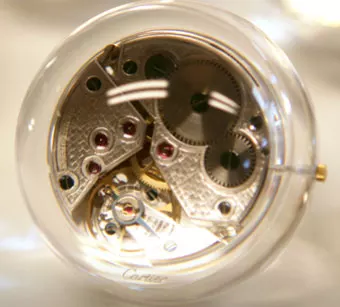 For much of its history Cartier designed watches in Paris while working with specialist Swiss movement and component makers. Today its watchmaking manufacture is based in La Chaux-de-Fonds, where development, prototyping and production bring together traditional watchmaking skills with modern manufacturing.
 In 2008 Cartier introduced the calibre 9452 MC flying tourbillon, certified with the Geneva Seal. In 2010 it introduced the self-winding 1904 MC, an important modern manufacture calibre named after the year associated with the creation of the Santos wristwatch. Alongside its mechanical movements, Cartier is also known for its métiers d’art: enamel, engraving, gem-setting and other decorative techniques shared with its jewellery workshops.
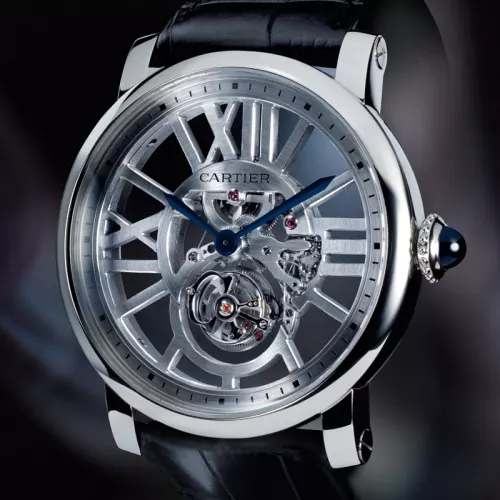 Among its best-known high-complication designs are skeleton watches whose bridges form large Roman numerals, a technique that turns the movement itself into the dial.
Main Cartier watch collections
- Santos de Cartier – the square watch with visible screws that descends from the 1904 original, now with an easily interchangeable bracelet and strap system.
- Santos-Dumont – a slimmer, dressier interpretation of the Santos on a leather strap.
- Tank – the rectangular family, including the Tank Louis Cartier, Tank Américaine, Tank Française and Tank Must.
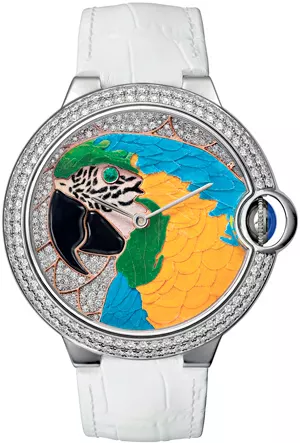
- Ballon Bleu de Cartier – a round watch introduced in 2007, recognisable by the crown protected by a metal arch and set with a blue cabochon.
- Baignoire – an oval watch whose elongated case is one of Cartier’s longstanding shaped-watch designs, offered today in both watch and jewellery-watch interpretations.
- Panthère de Cartier – a watch-and-jewellery design introduced in the 1980s, distinguished by its square case and supple bracelet.
- Pasha de Cartier – a round sports watch with a characteristic chain-linked crown cover.
- Cartier Privé – limited series that revisit historic shapes such as the Tank Cintrée, Tortue and Tonneau.
Cartier FAQ
Who owns Cartier?
Cartier belongs to the Swiss luxury group Compagnie Financière Richemont, which also owns watch brands such as Vacheron Constantin, Jaeger-LeCoultre and IWC.
Where are Cartier watches made?
In Switzerland. Cartier is a French house headquartered in Paris, but its watches are produced at its manufacture in La Chaux-de-Fonds.
What is the most famous Cartier watch?
The Tank, designed in 1917, and the Santos, created for Alberto Santos-Dumont around 1904, are the house’s best-known designs and remain at the centre of its collection.
How do you pronounce Cartier?
In French, approximately “kar-TYAY”. In English it is usually pronounced “KAR-tee-ay”.